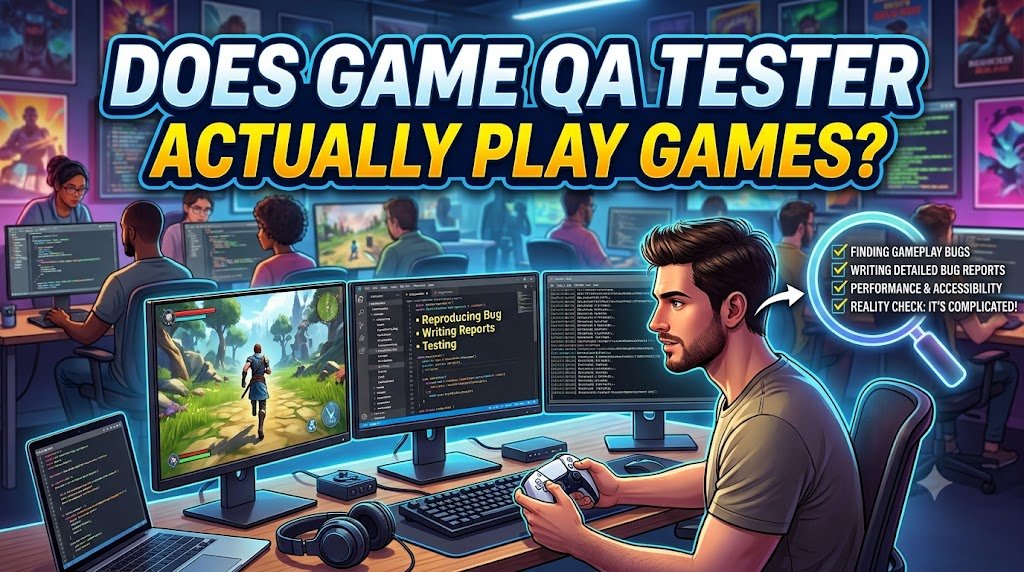
What Does a Game QA Tester Actually Do? A Realistic Career Overview
Every single game that we see online or offline goes through countless hours of testing before it is released. Behind every smooth gameplay is a team of dedicated professionals who fix every single detail of the game before it reaches the users. These professionals are known as Game Quality Assurance (QA) testers.
Many people think Game QA is nothing but people playing games for free all day long and getting paid for it. However, this is not true. Testing a game requires critical and analytical thinking, patience, excellent attention to detail, and strong communication skills. These professionals spend hours on a single game to analyze mistakes, document issues, reproduce bugs, and present the game exactly as it was intended.
What is a Game QA Tester?
Game Quality Assurance Testers are professionals who test video games during their development and analyze the issues that could negatively impact the launch of the game. Their main job is not to develop the game or decide game mechanics, but to ensure that the game meets all quality standards before being launched. Their work answers critical questions for developers, such as:
- Is the game safe or not?
- Can users exploit bugs?
- Does the gameplay remain stable?
- Does every feature of the game work properly?
Today, modern games include millions of coding factors and thousands of interconnected systems, including character movement, combat, physics, AI technologies, networking, audio, graphics, and many more. A small bug in the system can create a major problem. Without Game QA Testers, it would be impossible to detect and fix many critical issues. As a result:
- Games would crash frequently.
- Progress could be lost.
- Multiplayer would break.
- Players would encounter game-breaking bugs.
- Reviews would suffer.
- Studios would lose money and reputation.
Game QA Testers help developers fix these problems smoothly and efficiently.
Working of a Game QA Tester
The daily workflow is much more complicated than simply playing a game for fun. Their core responsibilities include:
- 1. Finding gameplay bugs: This is one of the primary responsibilities of a QA Tester—identifying visual bugs, audio bugs, UI glitches, and performance issues within the game, such as missing textures, flickering objects, broken animations, etc.
- 2. Test planning: The QA team structures a planned routine for all the tests required to ensure smooth gameplay. This includes testing every difficulty mode, verifying save functionality, testing all menu options, and more.
- 3. Writing a detailed report on bugs: It is necessary to document every issue clearly. A comprehensive report typically includes the bug title, description, build version, platform, actual vs. expected results, recorded videos, and crash logs. This helps developers fix the problem more efficiently.
- 4. Regression testing: Once a bug is fixed by the developer, the Game QA tester evaluates the game once again. They check if the bug was actually resolved and ensure that the fixing process did not accidentally introduce new issues into the system.
- 5. Compatibility testing process: Game QA Testers check the stability of the game across different devices. This includes PC systems, consoles, and mobile devices, as varying hardware specifications often reveal entirely new bugs.
- 6. Performance testing: Quality Assurance testers evaluate frame rate stability, loading speeds, memory usage, CPU usage, GPU performance, and battery consumption.
- 7. Accessibility testing: QA Testers ensure that modern games are accessible to all players regardless of their hardware or physical needs. They test color-blind modes, subtitle quality, text size scaling, controller remapping, screen reader compatibility, and high-contrast modes.
What Doesn't a QA Tester Do?
To keep expectations realistic, a QA Tester does not participate in the following phases:
- Play finished games for fun
- Choose game features
- Design levels
- Write stories
- Create artwork
- Balance gameplay mechanics
- Decide project release dates