Zorvyn Hiring Scam Exposed: Fake Offer Letters Are Targeting Indian Job Seekers in 2026
If you recently received a shortlisting email or an offer letter from a company called Zorvyn or Zorvyn FinTech, please stop and read this before you reply, share any documents, or click any link they sent you.
This is not a drill. Hundreds of job seekers across India — mostly in tech, finance, and startup roles — are receiving professional-looking emails from this company. And the more people dig into it, the more suspicious it gets.
A Bengaluru-based software engineer recently exposed the whole thing in a viral post on X (formerly Twitter), and what he found should make every job hunter in India pause and pay attention.
Related Post




What Is Zorvyn and Why Is Everyone Talking About It?
Zorvyn presents itself as a FinTech company that helps startups and small businesses build financial systems using artificial intelligence. Their website looks clean, their job listings sound legitimate, and their emails read professionally. On the surface, nothing seems obviously wrong.
But when you start digging, things fall apart quickly.
A software engineer named Asmit applied to a job listing from Zorvyn and was shortlisted for an assignment round. Before completing the task, he did what more of us should do — he researched the company first. What he found was enough to warn hundreds of thousands of people on social media.
Here is what he discovered:
First, the company’s website had logos of well-known, established companies placed alongside the Zorvyn name. These logos appeared to have been edited — as if someone had taken official brand logos and added Zorvyn’s name next to them to create a false impression of partnerships and credibility. This is a classic scam technique used to make a fake company look like it belongs in the industry.
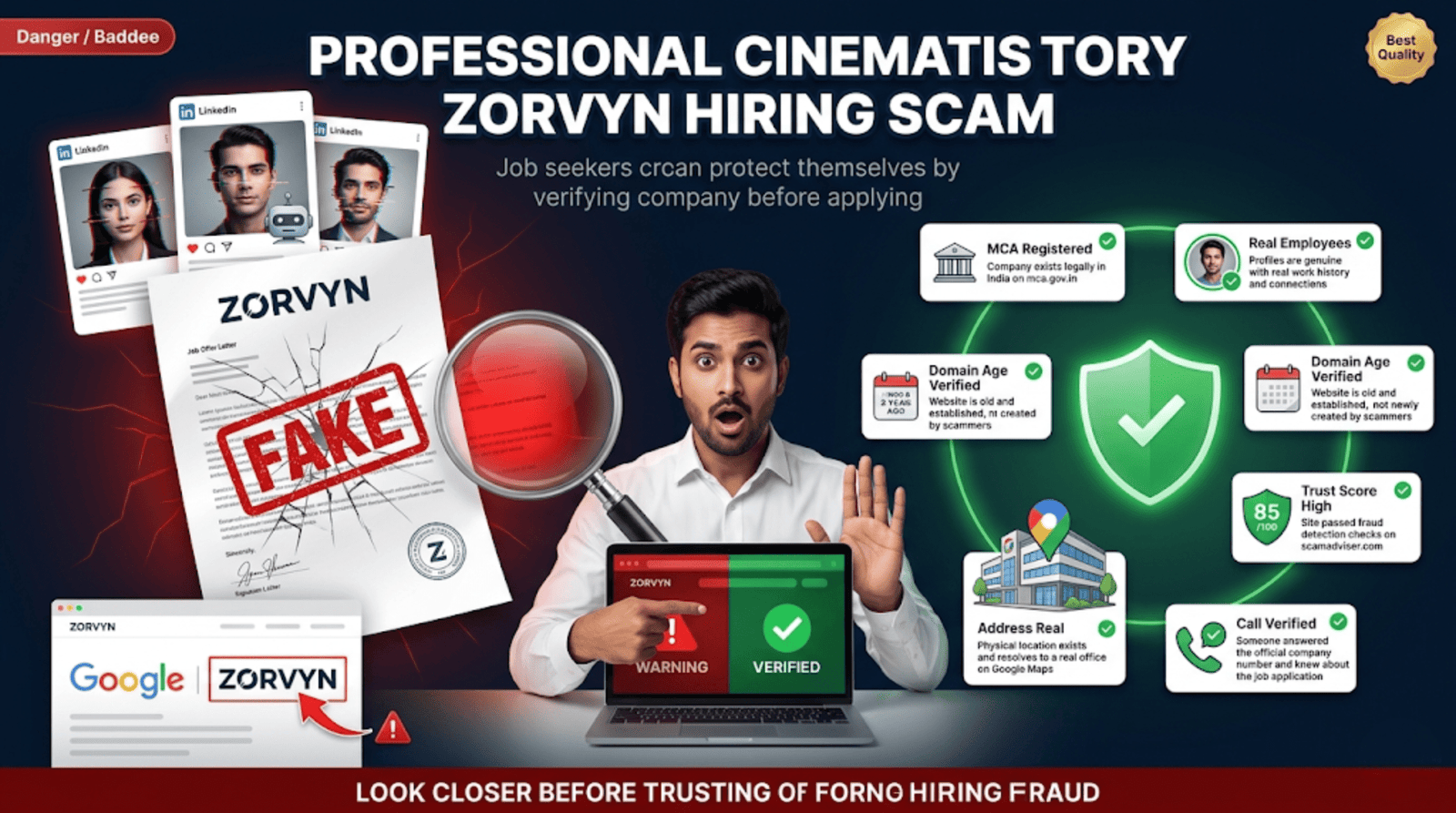
Second, when he looked at the employee profiles linked to Zorvyn on LinkedIn, the profile photos looked deeply suspicious. The faces were unnaturally smooth, the lighting looked artificial, and the overall feel was off. His assessment — and one many others agreed with — was that these were AI-generated profile pictures. People who don’t actually exist, created using image generation tools, assigned fake names and job titles, and used to populate the company’s LinkedIn presence with the appearance of a real workforce.
Third, independent fraud detection websites have flagged Zorvyn. Scam Detector gave zorvyn.io a trust score of just 30.7 out of 100, labelling it as medium risk with warnings for suspected phishing and spam activity. That is a terrible score for any legitimate company.
When Asmit shared all of this publicly, the response was overwhelming. People flooded the comments saying they had received similar emails. Several had already completed assignments and shared personal documents — not knowing who was on the other end receiving them.
As of April 2026, Zorvyn FinTech has not issued any official public response to these allegations.
How This Scam Actually Works
Once you understand how this type of fraud is structured, you start seeing it everywhere. The Zorvyn operation follows a well-known pattern used by fake hiring scams across India. Here is exactly how it unfolds from start to finish:
Step 1 — They post real-looking job listings
It all begins with job postings on platforms like LinkedIn, Naukri, Indeed, or through cold emails sent directly to candidates. The listings are written professionally. The job titles are real — software engineer, data analyst, financial consultant, product manager. The salary ranges are competitive. Nothing about the listing itself screams fake, which is why people apply without thinking twice.
Step 2 — They shortlist you way too fast
Real companies take time. They review applications, coordinate between teams, and usually take several days to a week before reaching out. Scam operations respond within hours. You apply in the morning and have a shortlisting email by evening. This speed is not a good sign — it is deliberate. The faster they move, the less time you have to look them up.
Step 3 — They send an assignment and quietly ask for documents
The assignment round seems completely normal. But alongside it — or sometimes before it — they ask you to submit documents for “background verification” or “onboarding preparation.” This is where it gets dangerous. They ask for your resume, your Aadhaar card, your PAN card, your address proof, and sometimes even your bank details. And because you think you are on your way to a real job, you hand it over without thinking.
Step 4 — A convincing offer letter arrives
Some people who went through the full process received what looked like a proper offer letter. Company letterhead, official-looking seal, your name and designation, salary breakdown, joining date — the works. It looks real because it is designed to look real. At this point, you are convinced you have got the job. Your guard is completely down.
Step 5 — They either vanish or ask for money
Here is where the operation reveals itself. Some fake companies simply disappear after collecting your documents. They got what they wanted — your personal data — and they will sell it, use it for identity fraud, or open credit accounts in your name. Others take a different route. They contact you and say that before you can join, you need to pay a small fee for a background check, for equipment, for training material, and for registration. They might call it a “refundable deposit.” It is not. Once you pay, they disappear.
9 Red Flags That Tell You a Company or Offer Letter Is Fake
These scammers are good at what they do. They engineer every part of the experience to feel exciting and legitimate. That is exactly why you need to slow down and check for these specific warning signs before you engage with any company you have not properly verified.
1. The employee profiles look AI-generated
Go to LinkedIn and search the company name. Click on a few employee profiles and look carefully at their profile photos. AI-generated faces tend to look unnaturally smooth, with perfect symmetry, strange hair edges, or eyes that seem slightly off. Beyond the photo, look at their profile history. Real professionals have years of connections, endorsements from real people, posts, comments, and activity going back over time. Fake profiles are usually thin, newly created, and suspiciously vague about past experience.
2. Company logos on the website look edited
Legitimate companies do not need to borrow other brands’ credibility. If you see major company logos on a startup’s website in a “clients”, “trusted by”, or “partnerships” section, zoom in and look carefully. Are those logos slightly off? Does the company’s name appear added awkwardly next to a famous brand logo? That is a manipulation technique. Real partnerships are mentioned in press releases and have verifiable confirmation from the other company.
3. They contacted you without you applying
Receiving an unsolicited shortlisting email from a company you have never heard of, followed immediately by next steps and urgency, is a red flag. Legitimate recruiters do reach out to candidates, but they have verifiable LinkedIn profiles, can explain how they found you, and never rush you into an assignment before you have had a proper conversation.
4. The entire process happens without a real interview
Think about it — real companies want to know who they are hiring. They schedule calls, conduct video interviews, ask technical questions, check your portfolio, and speak to you as a human being. If you have gone through the entire process and have an offer letter in your inbox without ever speaking to a single person on a video or phone call, that is not a real job offer. That is a scam.
5. They ask for sensitive documents before any contract
No legitimate employer needs your Aadhaar number, PAN card, or banking information at the shortlisting or assignment stage. Background verification happens after a formal contract is signed, and reputable companies use regulated third-party verification services — they do not ask you to email your ID documents directly to an HR email address before you have even had an interview.
6. The company has almost no independent online presence
Search the company name on Google News. Look them up on Glassdoor and AmbitionBox. Try to find any press coverage, industry mentions, or third-party references that are not from the company’s own website or social media. Real companies — even very small startups — leave digital footprints over time. If searching a supposedly active FinTech company turns up virtually nothing outside their own website, that absence is itself a major warning sign.
7. Their domain scores poorly on fraud-checking sites
Before you engage with any unfamiliar company, paste their website URL into scam-detector.com and scamadviser.com. These tools analyse dozens of signals — domain age, hosting patterns, links to known malicious sites, spam flags — and give you a trust score. Zorvyn.io received 30.7 out of 100. Anything below 50 should make you very cautious. Anything below 30 means walk away immediately.
8. The offer sounds too good to be true
A salary significantly above market rate for your experience level, with a role that requires minimal qualifications and promises fast growth — these are lures. They are designed to make you feel lucky so that you stop asking logical questions. If an offer makes you think “why would they choose me for this?”, trust that instinct and verify before proceeding.
9. They ask you to pay for anything at all
This is the single clearest indicator of a scam, and it has no exceptions. No legitimate company — anywhere in the world, at any scale — will ask you to pay money to work for them. Not for equipment. Not for background checks. Not for onboarding kits or training modules. Not for registration or security deposits. If money is being asked of you at any point in a hiring process, stop all communication immediately.
How to Verify Any Company Before You Apply or Share Anything
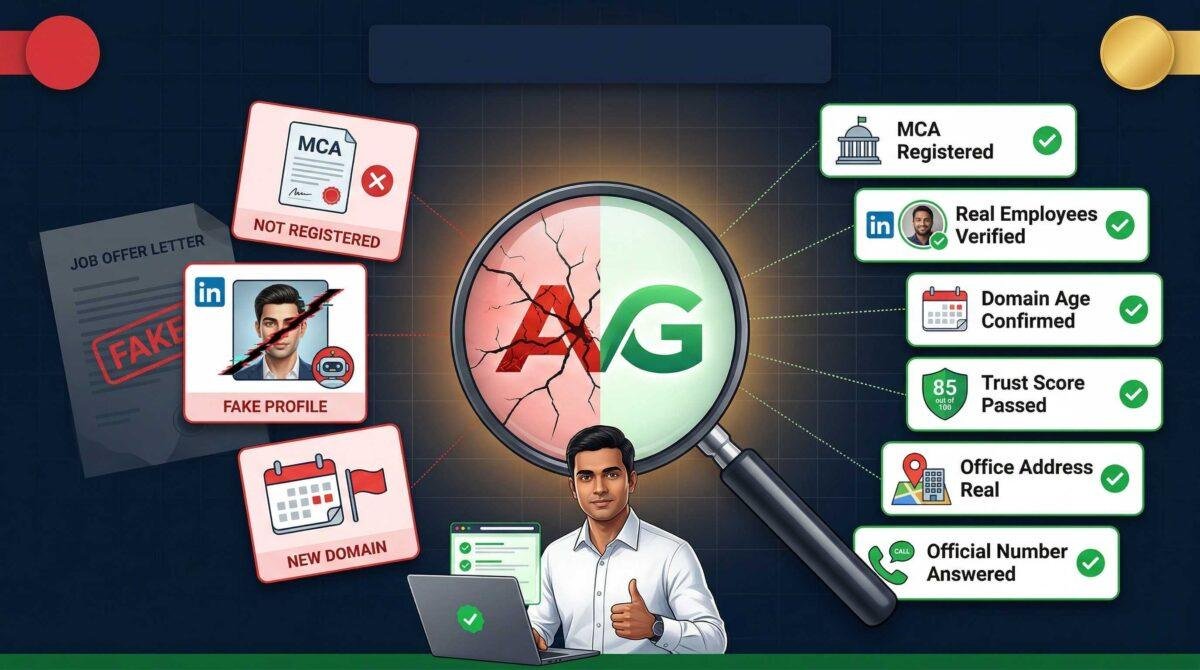
6 Free Checks Every Indian Job Seeker Must Do (2026)
This takes ten minutes and can save you from months of serious problems. Here is a simple, free verification process anyone can do:
Check MCA registration
Every company legally operating in India must be registered with the Ministry of Corporate Affairs. Go to mca.gov.in and search the company name under the “Company/LLP Master Data” section. If the company does not appear, it is not legally registered. End of story. A company that cannot be found on MCA has no legal standing to hire anyone in India.
Search Glassdoor and AmbitionBox
Go to glassdoor.co.in and ambitionbox.com and search the company. Genuine companies, even small ones with just ten or fifteen employees, tend to accumulate some reviews over time — interview experiences, salary information, employee feedback. A company with zero reviews and no profile information, despite supposedly operating for years, is suspicious.
Check how old the website domain is
Go to who?is or lookup.icann.org and type in the company’s website address. It will show you when the domain was first registered. A FinTech company that claims to have years of experience but whose website was created just a few months ago should raise serious questions about the story they are telling.
Look up their physical address on Google Maps
Find the address listed on their website or in their email and search it on Google Maps. A real office will usually show up with street view photos, user reviews, and business hours. If the address resolves to a random apartment building, an empty plot, or simply does not exist, something is wrong.
Call the number on their official website
Not the number in the email they sent you — the number listed on their official website. Call it during business hours and ask to speak with someone from their HR or recruitment team. If nobody answers, if the number is wrong, or if whoever answers has no idea what you are talking about, you have your answer.
Run their website through fraud-checking tools
Go to scam-detector.com and scamadviser.com and paste in their URL. Also, check transparencyreport.google.com/safe-browsing to see if Google has flagged the site for phishing or malware. All three tools are free and give you results in under a minute.
How to Tell If an Offer Letter Is Real
A nicely formatted PDF with a company logo means nothing on its own. Anyone with basic design skills can produce a convincing-looking offer letter in thirty minutes. Here is what actually makes an offer letter legitimate:
- The letter includes the company’s full registered address and a CIN number that you can verify on mca.gov.in
- The person who signed the letter can be found on LinkedIn with a verifiable professional history and real connections
- The email address it came from uses the company’s own domain — not Gmail, not Yahoo, not Outlook. For example, hr@companyname.io, not companyname.recruitment@gmail.com
- The salary and role details match what was advertised and are in line with normal industry rates for your experience and city
- You can call the company’s official number and confirm your application and offer with someone who actually knows who you are
- There is no request for payment of any kind at any stage of the process
- The joining instructions are clear, specific, and not rushed or vague
What to Do Right Now If You Have Already Shared Your Documents
First, breathe. You are not the first person this has happened to, and there are real steps you can take today to minimise the damage.
If you shared your Aadhaar number
Go to myaadhaar.uidai.gov.in and lock your Aadhaar biometrics immediately. This is a free feature that prevents anyone from using your Aadhaar for biometric authentication without your consent. You can unlock it any time you genuinely need to use it. Also call UIDAI’s helpline at 1947 to report the misuse.
If you shared your PAN card details
Check your credit report as soon as possible. You are entitled to a free annual credit report from CIBIL, Equifax, Experian, and CRIF High Mark. Look for any loan applications, credit card applications, or financial activity you did not initiate. If you find anything suspicious, report it to the relevant bank and file a complaint on cybercrime.gov.in immediately.
If you shared your bank account details
Call your bank’s customer care right away — not tomorrow, today. Tell them that your account details were shared with an unverified third party. Ask them to place a fraud alert on your account. If your account number and IFSC code were both shared, ask whether any additional security measures can be placed to prevent unauthorised transactions.
File a formal cybercrime complaint
Go to cybercrime.gov.in — this is the Government of India’s official national cybercrime reporting portal. Before you file, gather everything: screenshots of all emails, the offer letter, any WhatsApp messages, the company’s website URL, and any documents you were sent. The more evidence you submit, the stronger your complaint.
Call 1930 if it is urgent
India has a dedicated 24/7 financial cyber fraud helpline — dial 1930. If you have reason to believe your financial information is being actively misused, calling this number immediately is the fastest way to get official assistance.
Where to Report This Scam
- cybercrime.gov.in — File an official complaint with screenshots and evidence of the fraud
- 1930 — 24/7 national helpline for financial cyber fraud, call if you are urgently at risk
- 1947 — UIDAI helpline to report Aadhaar misuse and lock biometrics
- LinkedIn — Use the Report button on the Zorvyn company page and on any suspicious fake employee profiles to protect other job seekers
- Naukri / Indeed / LinkedIn Jobs — Use the “Report Job” feature on whichever platform you found the listing
- Local cyber crime police station — If you have suffered financial loss or confirmed identity theft, visit in person and file an FIR
Zorvyn FinTech has not responded to public allegations. Independent fraud detection platforms have flagged their domain with a trust score of 30.7 out of 100. A Bengaluru software engineer found what appear to be AI-generated employee profiles and edited company logos on their website. Hundreds of job seekers report receiving unsolicited shortlisting emails from this company.
Until Zorvyn can demonstrate valid MCA registration, real and verifiable employees, and transparent business operations, treat any communication from them as a serious risk to your personal information.
And more broadly: before you engage with any company you have not heard of before, spend ten minutes verifying them. Check MCA. Search Glassdoor. Look up the domain age. Run the website through a trust checker. Call their official number.
Legitimate companies will never mind you taking the time to verify. The ones that pressure you to move fast and act now — those are the ones you need to walk away from.